
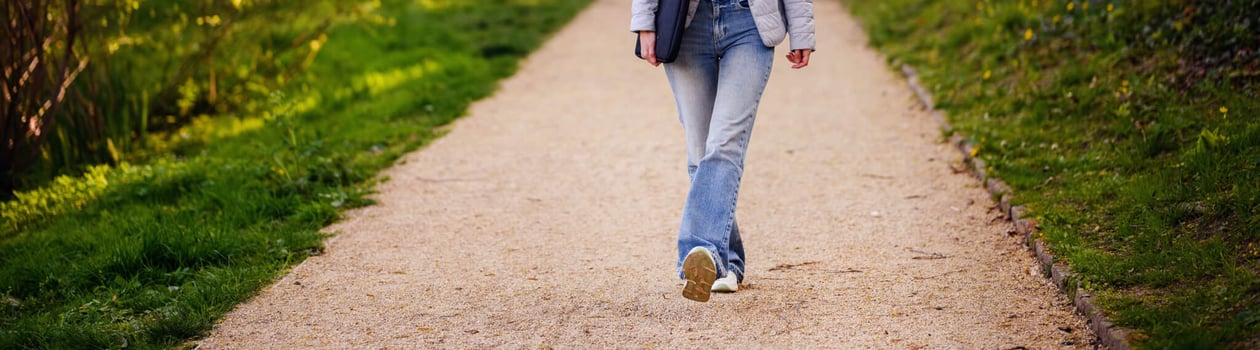
“I think that I cannot preserve my health and spirits unless I spend four hours a day at least – and it is commonly more than that – sauntering through the woods and over the hills and fields, absolutely free from all worldly engagements.”
Henry David Thoreau
The world around us is moving at such a hectic pace that we often forget to slow down and smell the proverbial roses.
Even our walk is at high speed, pushing every inch of haste we can get out of what is otherwise the most leisurely of modes of locomotion.
World Sauntering Day isn’t just an opportunity for us to remember to walk. It is, more importantly, an opportunity for us to take a genuinely relaxed tack to the day, and choose to saunter.
How to Celebrate World Sauntering Day
Try Sauntering
Give yourself plenty of time today, and do so with the intent of relaxing and truly enjoying your journey to wherever it is you have to go.
Saunter casually with pure relaxation, and take in the scents and sights. Greet others, and don’t let their urge to move quickly infect yours. In fact, see if you can get them to slow down and join you on your happy little saunter.
The world will be better for it, and you’ll be happier for it. World Sauntering Day is your opportunity to leave all the rush behind and just… Saunter… through your day.
Other things that you can do to celebrate World Sauntering Day include:
- Taking a break at lunchtime and going for a stroll around your local neighborhood or through the park
- Getting off the bus, train, or subway a stop or two early and taking a leisurely stroll the rest of the way to your destination.
- Wander along to your local coffee store and chill out with a hot cup of Joe in hand, watching the world go by.
- If you can’t get out for a walk, you can chill out at home too. The concept of sauntering melds with the Danish and Norweigan idea of Hygge. You are free to experience moments of contentment in your life without external pressures in whatever form they arrive.
Learn Interesting Sauntering Facts
DID YOU KNOW: It would take about 225 million years to walk one light-year at the pace of a 20-minute mile?
While you are away on your gentle walk on World Sauntering Day, consider the following:
Should being busy be your raison d’etre? Is running around all day, from one activity to another and never really pausing to take stock, really what you want from life? Probably not!
Celebrate World Sauntering Day by standing still for a moment or slowing down. Not only will you feel invigorated, but you may spot things you wouldn’t have noticed otherwise – the birds singing, the flowers blooming, or the love of your life brushing past you in the street.
World Sauntering Day Timeline
“Saunter” Enters English
The verb “saunteren” appears in Late Middle English with a sense of musing or wandering in thought, which later shifts toward physical, unhurried strolling.
Samuel Johnson’s Dictionary Spreads a Folk Etymology
In A Dictionary of the English Language, Samuel Johnson defines “saunter” as wandering idly and repeats a colorful but unsubstantiated derivation from French phrases about the Holy Land.
“Saunter” Comes To Mean Leisurely Walking
By the mid‑1600s, English writers were using “saunter” clearly in the modern sense of walking or strolling in an idle, unhurried way.
Thoreau Publishes “Walking”
Henry David Thoreau’s essay “Walking,” printed posthumously in The Atlantic Monthly, praises “sauntering” as an art and links slow, aimless walks in nature with spiritual and mental renewal.
Albert W. Palmer’s “Parable of Sauntering”
In The Mountain Trail and Its Message, minister Albert W. Palmer recounts John Muir’s preference for “sauntering” over “hiking,” popularizing the idea of walking mountains slowly and reverently.
Promenades Shape Urban Sauntering
Across Western Europe and the United States, designed promenades and pleasure walks in parks and boulevards foster the habit of leisurely public strolling as a key form of urban recreation.
Recreational Walking Becomes a Mass Pastime
Industrialization helps transform walking from necessity into leisure, as urban parks, early recreational trails, and walking clubs encourage ordinary people to stroll or ramble simply for pleasure.
History of World Sauntering Day
This holiday was formed by W.T. Rabe (fun fact: his son, John Rabe, is the local host for All Things Considered at KPCC in Pasadena) in 1979 as a response to the sworn enemy of the Saunter, jogging. It is thought to have started at the Grand Hotel on Mackinac Island in Michigan, USA.
The hotel has the longest porch in the world, measuring a lengthy 660 feet, or 200 meters if you work in metrics.
The whole thinking behind the day was to get people to slow down a little and take more note of the world around them. He was also the press relations office for the Grand Hotel, making it a pretty good bit of publicity for them!
The definition of the term ‘saunter’ is ‘to walk along in a slow and relaxed manner.’ The likely source of the word is the Middle English word, santren, which means “to muse.”
In 2002, Rabe’s son told journalists, ‘Sauntering, as my father would say, is going from point X to point Z, which means you don’t care where you’re going, how you’re going or when you might get there.’ The idea, he said, was to smell the roses and to pay attention to the world around you.
Jogging, in his view, was a grueling attack on the body. Rapidity and effort drained all the joy out of movement by making each step as painful as possible. Sauntering – the art of free movement from one location to another – was, in his view, unquestionably superior.
Over the years, Rabe gained a significant following. Other people began to see that he was onto something. Jogging might be what heart health professionals recommended, but it was draining people’s lives of joy. Where was the fun in the activity? Where was the relaxation?
Sauntering doesn’t just mean walking how you might if you were on your way to work. It also encompasses the idea that the weight of the world has been lifted from your shoulders. You walk free from stress and strain and can focus on the pure joy of the act.
It is the antithesis of jogging – a painful act that robs you of your experience of the outside world. It is more meditative and contemplative. You have the opportunity to experience life to the full instead of feeling puffed out and tired.
World Sauntering Day is your opportunity to head out into the world and approach it with a deeply relaxed air, a moment of pure clarity and joy, all while enjoying the beautiful world around you and everything it has to offer.
World Sauntering Day Facts
Flâneurs Turned City Streets into a Living Text
In 19th‑century Paris, the flâneur was celebrated as someone who wandered the streets without haste, simply observing life.
Writers like Charles Baudelaire and, later, cultural critic Walter Benjamin treated this slow, purposeless strolling as a serious way of “reading” the modern city, using the act of walking to understand crowds, consumer culture, and urban change.
“Saunter” Has an Etymology That Still Baffles Scholars
Although “saunter” feels like an old, earthy word, its origin is still uncertain.
Folk stories repeated by Henry David Thoreau linked it to French phrases like “à la Sainte Terre” (Holy Land), but modern etymologists reject these tales as romantic inventions.
Major references now simply list the origin as obscure, with early English uses appearing in the 17th century to describe idle or leisurely walking.
Thoreau Turned Sauntering into a Kind of Secular Pilgrimage
In his 1862 essay “Walking,” Henry David Thoreau argued that true “sauntering” was not aimless laziness but a kind of spiritual practice.
He contrasted the hurried businessperson with the walker who gives themselves over to the landscape for hours at a time, treating each slow step as a way to cultivate freedom, clarity, and a deeper connection with nature.
Slow Walking Helps Minds Wander, Which Boosts Creativity
Research at Stanford University found that people generated significantly more creative ideas while walking than while sitting, even when they walked on a treadmill facing a blank wall.
The studies did not require a fast pace; the simple act of moving at a comfortable walk appeared to loosen up thinking, suggesting that an unhurried stroll can be a practical tool for problem‑solving and imagination.
Light, Leisurely Walking Still Protects Long‑Term Health
Public health guidelines emphasize brisk walking, but large cohort and review studies show that even light‑intensity walking is healthier than being sedentary.
Harvard’s Nutrition Source notes that people who walk less than the recommended 150 minutes a week still reduce their risk of major depression and chronic diseases compared with non‑walkers, suggesting that unhurried daily strolls meaningfully contribute to long‑term well‑being.
Sauntering Through Nature Can Lower Stress Hormones
Spending time walking in green spaces appears to calm both body and mind.
Summaries of nature and mental‑health research from Harvard and other health organizations report that unhurried walks in parks and forests are linked with lower levels of stress hormones like cortisol, reduced blood pressure, and improved mood, compared with remaining indoors or in traffic‑heavy environments.
The Flâneuse Reclaims Slow Urban Wandering for Women
Originally, the archetypal flâneur was imagined as a man drifting anonymously through 19th‑century city streets.
Recent scholarship and essays have reclaimed the idea of the “flâneuse,” highlighting how women today use slow, observant walking to assert presence in public space, notice power dynamics in cities, and tell different stories about everyday urban life.
World Sauntering Day FAQs



You may also like
Take a Walk Outdoors Day
People have likely been taking a walk outside since the beginning of human history! And ever since people have made the habit of living indoors, it has been a delight for them to get outdoors for a walk in the fresh air.
- Australia
- Canada
- International
- and 2 more
National Walking Day
Take in the fresh air and soak up the scenery — a great way to get exercise, clear your mind, and explore the world around you.
- United States

National Walking the Dog Day
Take your furry friend on a leisurely stroll and explore the outdoors together. Bond, get exercise, and breathe in the fresh air!
- Australia
- Canada
- United Kingdom
- and 1 more

Walk to Work Day
Good for your physical health, good for your mental health, good for the planet. Take some extra time in the morning to walk to work and reap all these benefits.
- Australia
- Canada
- International
- and 2 more
National days and holidays on June 19

International Box Day
Cats and cardboard boxes, it's a classic love affair! See your furry friend's eyes light up as they pounce, hide and play in their favorite cardboard creation.
- Canada
- United Kingdom
- United States

Ugliest Dog Day
Celebrate Ugliest Dog Day by honoring lovable “so-ugly-they’re-cute” pups, exploring famous ugly breeds, and embracing the joy that inner beauty brings.
- Canada
- United Kingdom
- United States

National Pets in Film Day
Celebrate National Pets in Film Day by honoring animal movie stars, learning about humane training, enjoying classic pet films, and supporting animal shelters.
- United States

National Watch Day
Celebrate National Watch Day by honoring classic and modern timepieces, exploring watchmaking history, and enjoying the style, craft, and precision of horology.
- Japan
- United Kingdom
- United States
Seize Every Day
Join free for personalised recommendations, email reminders and exclusive guides. Never miss a day.