
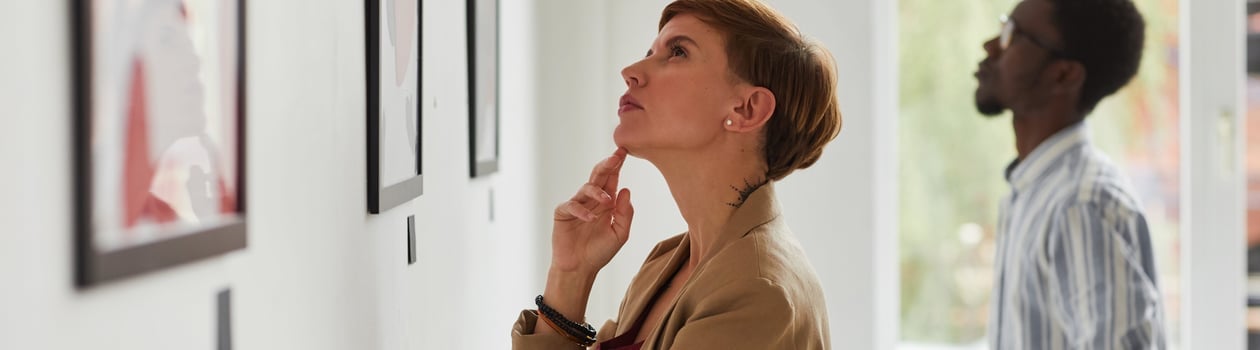
Did you know that most people spend less than 30 seconds looking at a piece of art? Slow Art Day invites everyone to change that rhythm. This global event encourages visitors to slow down and spend real, unhurried time with each artwork, trading speed for attention and quantity for quality.
Instead of rushing through galleries like they are checklists, participants are guided to observe a few selected pieces for several minutes each. The goal is to deepen the connection between the viewer and the art, leaving room for personal interpretations, curiosity, and small discoveries that only show up when someone sticks around long enough to notice them.
Taking time to observe art slowly can lead to surprising insights. When viewers focus on fewer pieces, they often catch details that would otherwise slip by: a faint underlayer of paint, a repeated symbol, a subtle change in expression, a hidden joke in the background, the way the light was imagined rather than copied, or the way a sculpture “moves” when someone circles it.
Slow looking also changes the viewer, not just the viewing. It invites mindfulness and reflection without requiring any special training. A person can notice how attention shifts, how assumptions pop up, how the mind wants to label and move on, and how a longer look creates space for feeling as well as thought.
By engaging more deeply, individuals can experience a more meaningful connection with the art and, by extension, with their own memories, ideas, and emotions.
How to Celebrate Slow Art Day
Here are some fun and thoughtful ways to make the most of Slow Art Day. Each one adds a different layer to the experience.
Pick Just a Few Pieces
Choose a small number of artworks instead of trying to see everything. For many people, three to five artworks are enough. The goal is not to “cover” the gallery. The goal is to give attention long enough for the artwork to begin speaking back.
A practical approach is to select pieces with different formats. For instance, one painting, one sculpture, and one photograph. Each medium asks for a slightly different kind of look. A painting may draw attention to brushwork, color relationships, and composition. A sculpture may reward walking around it and noticing how shadows change. A photograph can invite questions about framing, time, and what remains outside the edges.
While observing closely, try moving through several layers of observation:
- First impressions: What is the immediate reaction? Attraction, confusion, amusement, discomfort, boredom?
- Inventory: What is actually present? Shapes, lines, colors, textures, objects, people, and patterns.
- Relationships: Where does the eye go first, and why? How do areas of the work interact with each other?
- Details: What is small enough that it might be missed in a quick glance?
- Meaning-making: What story, mood, or idea begins to emerge after a few minutes?
It can also help to change the distance. Stand far away to see the whole composition, then step closer to notice surface details. If seating is available, use it. Looking for longer becomes easier when the body feels comfortable.
Visit a Local Gallery
Find a nearby museum or art space. Many participate in Slow Art Day with special activities such as guided slow-looking sessions or facilitated discussions. Even when a venue does not offer a formal program, it can still be an excellent place to practice because the setting is designed for attention: good lighting, quiet corners, and artworks displayed with care.
If a guided experience is available, it is worth trying at least once. A facilitator often models patient observation and asks open-ended questions that make the artwork feel more approachable. Effective prompts are simple but powerful:
- What is happening in this artwork?
- What do you notice that makes you say that?
- What else can be discovered?
Group conversation can be especially revealing because people notice different things. One viewer may notice a small symbol that changes the meaning of the entire piece. Another may connect a color palette to a personal memory. Someone else may focus on technique or materials. Hearing those perspectives does not “solve” the artwork. It expands it.
For anyone who feels nervous about not knowing enough, Slow Art Day is a gentle reminder that expertise is not required. Curiosity is enough. Museums can feel intimidating when they resemble tests. Slow looking turns them back into places of experience.
Try It at Home
Slow Art Day does not require a museum visit. Slow looking works in a living room, a classroom, a library, or any quiet space with a few minutes available. Pick up an art book, a postcard, a print on the wall, or an online image. Then treat it as if it were the only artwork in the world for a short while.
To make a home session feel special, set up a few simple supports:
- Reduce distractions: Silence notifications, lower background noise, and give the artwork full attention.
- Use a timer: Setting five or ten minutes can help the mind remain focused rather than drifting away.
- Write or sketch: Jot down what you notice, or make a quick sketch of the composition. Drawing is not about talent here. It is simply a way to slow the eyes down.
- Ask one deeper question: What might the artist have been exploring? What emotion does the work seem to hold? What would change if one element disappeared?
Home viewing can also highlight how context shapes experience. A painting seen on a screen feels different from one seen in person. Texture, scale, and even the sense of shared space matter. Noticing those differences is part of the learning.
Make It Social
Invite a few people to join. Slow Art Day can be surprisingly enjoyable as a group activity because it replaces the usual gallery chatter of “Let’s go, let’s go” with shared attention. A simple format works well:
- Everyone looks at the same artwork silently for several minutes.
- Each person shares one observation, not an interpretation.
- Then everyone shares interpretations, questions, and emotional reactions.
Beginning with observations keeps the conversation grounded. It also helps people who worry they might “say the wrong thing.” Saying “There is a red triangle near the corner” is simple. From there, meaning can develop naturally.
To keep the atmosphere welcoming, it helps to establish a few gentle ground rules: no interrupting, no mocking, and no rushing to sound clever. Slow Art Day discussions work best when they feel like exploration rather than debate.
For groups with children or first-time museum visitors, turning it into a game can help. Each person can search for one element: a surprising texture, an unusual detail, a repeated shape, a clue about the time period, or a color that appears in more than one place. This creates focus without forcing the artwork into a single “correct” interpretation.
Reflect Afterward
Take time to think about the experience. Reflection is where slow looking turns from a pleasant exercise into a lasting habit. It does not need to be complicated. A few sentences can capture what changed.
Some useful reflection prompts include:
- Which artwork held your attention the longest, and why?
- Did your first impression change after a few minutes?
- What detail felt like a “new discovery”?
- What emotion appeared unexpectedly?
- What felt difficult about slowing down?
Reflection also helps people notice how they normally move through visual spaces. Many modern environments train speed: scrolling, swiping, skimming. Slow Art Day offers a counterbalance. People may even extend the practice beyond art spaces, using the same attention to notice architecture, design, nature, or everyday objects.
Slow Art Day Timeline
Opening of the Louvre as a public museum
The former royal palace in Paris opens to the public as the Musée du Louvre, helping to establish the modern idea of an art museum where ordinary citizens can spend time viewing masterpieces. [1]
John Ruskin publishes “The Queen of the Air”
Art critic John Ruskin urges readers to look slowly and attentively at paintings and natural forms, influencing Victorian audiences to see careful, moralized observation as central to art appreciation. [1]
Marcel Duchamp’s “Nude Descending a Staircase, No. 2” shocks New York
Displayed at the Armory Show, Duchamp’s painting confounds viewers used to quick recognition, encouraging new conversations about how long and how deeply one must look to understand modern art.
MoMA’s “Art in Our Time” reframes museum viewing
The Museum of Modern Art’s landmark exhibition experiments with display and interpretation, shaping 20th-century expectations that museums should help visitors actively engage with and think about what they see. [1]
Publication of “Ways of Seeing” by John Berger (TV series 1972)
Berger challenges traditional art history and encourages viewers to question how they look at images, bringing the idea of active, reflective looking at art to a wide popular audience. [1]
Abigail Housen begins research on aesthetic development
Housen’s empirical studies show that people’s understanding of art deepens through sustained, reflective looking, laying groundwork for educational approaches that prioritize time and dialogue with artworks.
The Visual Thinking Strategies program was developed
Philip Yenawine and Abigail Housen formalize Visual Thinking Strategies, a method that has students look quietly at a single artwork and discuss what they see, helping to popularize “slow looking” in museums and classrooms. [1]
History of Slow Art Day
In 2008, Phyl Terry visited the Jewish Museum in New York City. Instead of rushing through the exhibits, he chose to focus on just two paintings: Hans Hofmann’s Fantasia and Jackson Pollock’s Convergence.
By spending extended time with these artworks, he discovered a deeper connection and appreciation. A longer look created space for questions that rarely appear when someone moves quickly: How was this made? What rhythm does the composition have? Where does the eye feel drawn, and where does it resist going? What does the work feel like at minute one compared to minute ten?
That experience led him to wonder whether others might benefit from slowing down their art viewing as well. The idea was refreshingly simple. Museums often encourage visitors to see many works, but seeing many works can mean noticing very little. Terry’s approach suggested a different way of measuring a successful visit, one based on depth rather than distance traveled.
Encouraged by this insight, Terry organized an initial event in 2009, inviting a small group to engage in slow looking at selected artworks. The positive response revealed that the practice was not only personally meaningful but also socially valuable.
People enjoyed taking time, and they enjoyed talking afterward. The conversation element mattered because it showed how varied human perception can be. Two people can stand in front of the same artwork and leave with completely different experiences, and both can be valid.
That momentum led to the establishment of Slow Art Day as an annual event in 2010 to transform how people engage with art. The format that developed often includes three elements: dedicated time to look quietly, an invitation to reflect on what is being noticed, and a chance to share observations in a group discussion. These steps make slow looking accessible. People do not need a lecture to participate. They need time, permission, and a little structure.
Since its beginnings, Slow Art Day has grown into a global movement. Each year, museums and galleries around the world invite visitors to spend more time with fewer artworks, encouraging deeper observation and personal interpretation.
Some venues select a small set of works and provide seating or prompts. Others integrate slow looking into tours or educational programs. Some encourage visitors to bring notebooks, sketch quietly, or share reactions in a casual discussion afterward.
The initiative emphasizes that anyone can appreciate art without specialized knowledge. This message is especially important because many people remain at the surface of art experiences out of fear: fear of misunderstanding, fear of appearing uncultured, or fear of saying something “wrong.”
Slow Art Day reframes art as a relationship rather than a puzzle. If someone spends time with a work and notices honestly, that attention itself becomes a form of participation.
By slowing down, participants often notice details and form connections they might otherwise miss. A background figure might mirror the main subject. A color choice might create tension or calm.
Empty space may do as much work as the filled space. Materials can also become part of the meaning, especially in contemporary art, where texture, found objects, or unusual processes carry their own messages.
This approach has resonated widely, leading to continued growth and global participation. It fits within a broader cultural interest in mindfulness, intentional living, and meaningful leisure.
It also supports a practical goal for arts organizations: helping visitors have experiences they remember, not just visits they complete. Slow Art Day offers a small but powerful reminder that looking is an active skill, and like any skill, it becomes richer with time.
Slow Looking Reveals More Than a Quick Glance
Most people spend surprisingly little time with individual artworks in museums, often moving on after only a few seconds.
Yet research and art education practices suggest that slowing down and spending longer with a single piece can transform what viewers notice and understand.
Studies on museum behavior, educational methods like Visual Thinking Strategies, and neuroscience research all point to the same idea: extended viewing helps the brain detect patterns, relationships, and meanings that quick glances simply miss.
Most Museum Visitors Look at Art for Less Than Half a Minute
Visitor studies have consistently found that people typically spend only a few seconds with each artwork.
A widely cited 2001 study at the Metropolitan Museum of Art in New York, for example, measured “dwell time” and found that visitors looked at individual paintings for an average of 27.2 seconds, including time spent reading labels, before moving on to the next object.
“Slow Looking” Has Deep Roots in Art Education
Long before the phrase “slow art” became popular, museum educators were developing methods to help people linger with artworks.
Since the late 1980s, approaches like Visual Thinking Strategies (VTS) have asked viewers to spend extended time discussing a single piece, using open-ended questions to build observation and interpretation skills rather than racing through many works.
Extended Viewing Can Change What the Brain Notices
Neuroscience research shows that when people look at complex images for longer periods, their brains recruit higher-order visual and cognitive areas, allowing them to detect patterns and relationships that are missed at a glance.
Studies using functional MRI and eye tracking suggest that initial viewing is dominated by rapid, bottom‑up reactions, while prolonged viewing involves more deliberate, top‑down processing and richer meaning‑making.
Slow Engagement With Art Supports Mindfulness and Stress Reduction
Clinical and psychological studies have linked unhurried art viewing to lower stress and increased feelings of calm.
Programs in hospitals and medical schools that incorporate reflective time with artworks report reductions in perceived stress and burnout among participants, along with improvements in mood and self‑reported mindfulness, suggesting that slow engagement with art can function as a kind of contemplative practice.
Looking Slowly at Art Can Train Empathy and Observation Skills
Medical and professional schools now use extended art observation sessions to sharpen students’ abilities to notice detail and understand other people’s perspectives.
Research with medical students at institutions such as Yale and Harvard has found that carefully studying a single artwork and discussing it as a group improves diagnostic observation skills and increases empathy scores compared with control groups who do not participate in such art‑based training.
Slow Art Viewing Can Enhance Memory for What Is Seen
Cognitive psychology research indicates that giving more attention to dwell on a visual scene strengthens encoding into long‑term memory.
Experiments where participants study images for different durations show that longer exposure leads to more accurate later recognition and richer recall of details, suggesting that slow looking not only deepens understanding in the moment but also makes the experience more memorable.
Deliberate Looking Helps Viewers Move Beyond First Impressions
Studies of aesthetic experience show that people’s initial reactions to artworks are often based on quick judgments of liking or disliking, but that these reactions can shift significantly with extended viewing.
When viewers are asked to spend several minutes with a single piece, they report discovering new elements, revising their opinions, and feeling a stronger emotional connection than they did during their first few seconds of contact.
Slow Art Day FAQs
How long do people typically look at a single artwork in a museum?
Studies of visitor behavior in large art museums have found that people often spend less than half a minute in front of a single work, and sometimes only a few seconds.
For example, research at the Metropolitan Museum of Art and other institutions using timing and tracking methods has repeatedly shown very brief viewing times, with visitors tending to move quickly through galleries rather than engaging in extended looking. [1]
What are the benefits of spending several minutes with one artwork instead of moving quickly through a gallery?
Spending longer with one artwork gives the viewer more time to notice formal details, such as brushwork, color relationships, and composition, as well as subtle narrative elements or symbolic references.
Museum education research suggests that extended looking can improve recall of what has been seen, deepen emotional engagement, and support more complex interpretation, since the viewer cycles through first impressions, questions, and new observations rather than stopping at an initial glance.
How does “slow looking” at art relate to mindfulness practices?
Slow looking shares key features with mindfulness, including sustained attention, nonjudgmental observation, and awareness of one’s own thoughts and feelings as they arise.
Programs in art museums that integrate mindfulness techniques, such as guided breathing and prolonged viewing of a single artwork, have been associated with reduced stress, improved mood, and a stronger sense of presence, similar to benefits reported in other contemplative practices.
Do people need an art history background to get value from looking at art slowly?
Research in museum education indicates that prior art knowledge can enrich interpretation, but it is not required for meaningful engagement.
When visitors are encouraged to take their time, describe what they see, and connect the work to their own experiences, they often develop personal insights regardless of their level of training.
Approaches such as Visual Thinking Strategies show that careful observation and open-ended discussion can support deep learning even for complete beginners.
Can slow viewing change someone’s interpretation of an artwork over time?
Extended viewing commonly leads to shifts in interpretation. As a person spends more time with a work, initial reactions, such as liking or disliking it, may soften or reverse as new details are noticed and alternative readings emerge.
Studies of audience engagement show that viewers who revisit the same work over several minutes often refine or complicate their original ideas, moving from quick judgments to more layered understandings that combine visual evidence, personal associations, and contextual information.
Is there a historical precedent for contemplative or prolonged viewing of visual art?
Many artistic traditions have long emphasized lingering with images. In Byzantine and Eastern Orthodox Christianity, for example, devotional icons are intended for repeated, meditative viewing.
In traditional East Asian art, hanging scrolls and handscrolls are often unrolled slowly and contemplated section by section. Connoisseurs of Chinese painting and calligraphy historically spent extended periods examining brushwork and inscription details, treating the viewing itself as a cultivated practice.
How can someone practice slow looking if they only have a short time in a museum?
Even on a brief visit, a person can choose just one or two works and commit a set amount of time, such as five or ten minutes, to each.
A simple approach is to divide the time into stages: first, taking in the whole image, then scanning for details, then reflecting on questions or emotional responses.
Some museums provide benches, sketching materials, or prompts that can help structure this process, but an individual can also set a timer and silently note what changes in their perception as the minutes pass.



You may also like
Museum Selfie Day
Museums weave together history, art, and knowledge into living stories that invite exploration and reflection. Far from being static spaces, they are dynamic environments where the past meets the present and helps shape the future. Standing before a painting, artifact, or installation can spark curiosity, ignite creativity, and open doors...
- Australia
- Canada
- International
- and 2 more

Smithsonian Day
On Smithsonian Day, also known as Museum Day, museums across the United States offer free admission to visitors with a special ticket. Hundreds of institutions take part, including science centers, history museums, art galleries, and zoos. Each guest can visit one participating location of their choice at no cost. This...

National Slow Cooking Month
Effortlessly preparing delicious meals with a kitchen appliance known for its convenience and culinary magic.

International Museum Day
Celebrate International Museum Day by exploring museums, discovering world history and culture, and enjoying interactive learning for all ages around the globe.
- Canada
- France
- United Kingdom
- and 1 more
National days and holidays on April 10 2027

National Siblings Day
Show your siblings you appreciate them, even if you sometimes want to kill them, or volunteer to adopt-a-sibling and enrich some else’s life on Siblings Day.

National Erase Self-Negativity Day
Some studies have shown that 80% of the thoughts running through an average person’s mind are negative – tipping the scale much too far away from the positive thoughts that most people desire! To live healthy and happy lives, people may need to do a bit of work to create thought...

National Hug Your Dog Day
Give that furry creature a special celebration by enjoying National Hug Your Dog Day with them.

National Public Health Week
The well-being of communities — disease prevention, and better living through knowledge and action, towards a healthier world.
Seize Every Day
Join free for personalised recommendations, email reminders and exclusive guides. Never miss a day.