
World Tessellation Day celebrates the satisfying moment when shapes click into place and a blank page turns into a repeating world. It is a day for noticing patterns that usually fade into the background, like tiled floors, brickwork, textiles, and digital designs, and for trying a little pattern-making at home.
A tessellation is a set of shapes that covers a flat surface without gaps or overlaps. Some tessellations are as familiar as a checkerboard; others feel like visual magic, with interlocking forms that look like animals, leaves, or waves. Once people learn the idea, it becomes hard not to see tessellations everywhere, from crafted objects to everyday architecture and the textures used in games and graphics.
How to Celebrate World Tessellation Day
Craft Your Tessellation Art
A hands-on art session is one of the easiest ways to celebrate. Paper, scissors, tape, and colored pencils are enough to build a tessellation from scratch, and the process makes the “no gaps, no overlaps” rule feel real.
A friendly starting point is a square. Cut a small curved or zigzag piece off one side of the square and tape it to the opposite side, keeping the edges aligned. The tile still repeats cleanly, but it now has personality. Trace it across the page, sliding it side to side and then down in rows. The pattern will lock together like a custom puzzle, even though it was made from a simple base.
After the first successful page, try making the tile look like something recognizable. A bump can become a beak; a notch can become a tail. Adding details after the tiling step can be less stressful than trying to draw the perfect creature first, because the fit is already guaranteed. Coloring can emphasize repetition by using the same palette for every tile, or it can highlight symmetry by alternating colors in a planned sequence.
For a challenge, build a tessellation that repeats by rotation instead of sliding. The best way to approach this is to think about meeting points. Tiles that rotate around a point need angles that work together smoothly, so the corners “share” the space without forcing gaps. It is a great reminder that a tessellation is both art and geometry, and both sides matter.
Nature’s Tessellations Treasure Hunt
A tessellation hunt turns a walk into a pattern-spotting game. While many natural surfaces are not perfect mathematical tessellations, they often come close, and comparing “almost” patterns to strict ones builds sharp observation skills.
Honeycomb is the famous example, since hexagons pack efficiently. But there are plenty of other places to look. Repeating scales on pinecones, layered patterns on certain seed pods, or the cracked networks in dry ground can all suggest tiling. Some examples repeat a shape closely; others repeat an idea, like a branching or spiraling structure that hints at the same kind of order.
A useful part of the hunt is sorting discoveries into two categories: true tessellations and tessellation cousins. Turtle shells and many leaf arrangements look tiled, but the shapes may vary in size and the surface may curve. That does not make them “wrong.” It makes them interesting. Nature has to grow, adapt, and bend, while a plane geometry tessellation can stay perfectly consistent forever.
Participants can sketch what they find, take photos, or recreate a discovered pattern later using paper cutouts. The goal is attention, not perfection, and the payoff is realizing how often pattern solves real-world problems like packing, stability, and coverage.
Tessellation Party Time
A tessellation-themed gathering can be simple and playful. It works well for families, classrooms, or any group that likes making things together, because the activity invites experimentation and conversation without needing a long introduction.
For decor, repeat one strong shape or motif. A wall of paper tiles that guests add to over time becomes a collaborative artwork, and it naturally shows how small pieces build into a larger system. Tables can have pattern blocks, tangrams, or cut-paper tiles so people can test what fits and what does not.
Food can join the theme in low-effort ways. Sandwiches cut into triangles can tile a platter. Square crackers can become a grid. Hexagon-shaped cookies, or snacks arranged in repeating rows, reinforce the idea that tessellations are about coverage and repetition, not about a single “correct” design.
Activities can include a friendly tile challenge: everyone starts with the same base shape and gets a set time to modify it into something that still tessellates. When the time is up, each person tiles a small patch and labels the symmetry moves they used, like sliding, turning, or flipping. Voting categories can keep it light, such as “Most Surprising,” “Most Elegant,” or “Most Likely to Become Wallpaper.”
Educational Escapades
World Tessellation Day also fits naturally into learning, because tessellations are a practical doorway into geometry. They make abstract ideas visible and testable with a pencil and a pair of scissors.
A good place to begin is with symmetry moves. Sliding a tile is translation. Turning it around a point is rotation. Flipping it like a mirror is reflection. These are not just vocabulary words; they are the tools that make patterns repeat predictably.
From there, it helps to explore why some shapes tessellate easily on their own. When regular shapes meet around a point, their angles need to add to a full turn. That simple requirement explains why equilateral triangles, squares, and regular hexagons are such dependable tilers. It also explains why other regular polygons cannot tile the plane by themselves without leaving gaps. Seeing that rule play out on paper makes it stick.
Older students and curious adults can go further by exploring patterns that mix shapes, like combinations of triangles and hexagons, or by looking at tilings that do not repeat in a simple way. Even without heavy theory, experimenting with mixed tiles shows how local decisions at corners control the entire design.
Digital tools can support the learning, too. Drawing apps and design software often use repeating textures and pattern fills that rely on tessellation principles. Recreating a hand-made tile digitally can be a satisfying bridge between craft and modern design, and it shows why tessellations matter in graphics, manufacturing, and materials.
World Tessellation Day Timeline
Sumerian Clay Cone Mosaics
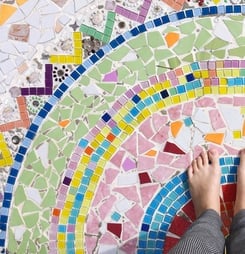
Early Mesopotamian builders in Uruk and other cities pressed colored clay cones into wet plaster to create repeating geometric wall mosaics that function much like tessellated patterns.
Roman Geometric Mosaic Floors
Roman artisans laid tiny stone and glass tesserae into mortar to form large geometric pavements, giving Latin “tessera” as the root of the modern mathematical term “tessellation.”
Geometric Tessellations in the Alhambra
Nasrid craftsmen covered the walls of the Alhambra palace in Granada with richly colored tilework and carved stucco that mathematicians now study as sophisticated examples of plane tessellations.
Kepler’s Harmonices Mundi and Early Tiling Theory
Johannes Kepler publishes “Harmonices Mundi,” giving one of the first systematic analyses of tilings by regular polygons and illustrating patterns now recognized as regular and semi-regular tessellations.
Fedorov Proves the 17 Wallpaper Groups
Russian crystallographer Evgraf Fedorov shows there are exactly 17 plane crystallographic symmetry groups, providing a rigorous classification of periodic tessellations used in crystallography and geometry.
Penrose Introduces Aperiodic Tessellations
Roger Penrose discovers sets of tiles that force non-repeating patterns, including the famous kite-and-dart Penrose tilings, expanding tessellation theory beyond strictly periodic designs.
M. C. Escher Popularizes Tessellations in Art
Dutch artist M. C. Escher creates woodcuts and lithographs filled with interlocking animals and figures based on geometric tilings, bringing tessellations into popular culture and inspiring generations of math-art enthusiasts.
History of World Tessellation Day
World Tessellation Day began in 2016 as an invitation to make and share tessellations, especially within math and art communities. The day quickly found a home among educators, students, artists, and pattern enthusiasts who liked that it welcomed both careful reasoning and open-ended creativity.
The date is tied to the birthday of the Dutch artist M.C. Escher, whose work helped bring tessellations into popular imagination. Escher did not just repeat squares and triangles. He transformed tiling into storytelling. Birds become fish; lizards crawl into the negative space left by other lizards; interlocking creatures create a scene that stretches beyond the edges of the page. The images feel playful, but they are built on strict structure, and that balance is part of why his prints remain so influential.
While Escher is a major modern reference point, tessellations themselves are much older than the holiday. People have used repeating patterns for centuries in decorative arts and architecture because tiling is durable, scalable, and visually coherent. Repetition makes large surfaces feel unified, and geometric patterns can be expanded without needing a new plan for every corner. Across cultures, tiling traditions have shown how much variety can come from a limited set of shapes, especially when symmetry and color are handled with care.
World Tessellation Day grew out of that long fascination with patterned surfaces, but it focuses on participation. It encourages people to try a tessellation, not just admire one. That can look like a classroom activity about angles, an art project about negative space, or a design experiment that turns one handmade tile into a full pattern.
The celebration also reflects the way tessellations show up in modern life. Designers use repeating patterns in textiles, packaging, and branding because repetition creates rhythm and consistency. Builders rely on tiling and modular panels for efficiency and repair. In digital spaces, tessellated textures create seamless backgrounds and believable surfaces, and the same underlying idea supports everything from decorative pattern fills to more technical uses in computing and materials science.
At its heart, World Tessellation Day is about seeing what happens when constraint becomes a creative tool. A tile has to fit, every time. That rule can feel limiting until the first time a pattern finally locks together. Then it becomes motivating. The day invites anyone who is curious to chase that click of satisfaction, and to look at the everyday world as a gallery of repeating shapes.
Facts About World Tesselation Day
Penrose Tilings Helped Mathematicians Rethink Order and Symmetry
In the 1970s, Sir Roger Penrose discovered families of “aperiodic” tiles that cover the plane without ever forming a repeating wallpaper pattern, now known as Penrose tilings.
These tessellations exhibit long-range order and intricate fivefold symmetry but never repeat exactly, which challenged earlier assumptions that order in a tiling had to be periodic and later helped scientists interpret similar non-repeating structures in quasicrystals.
Islamic Geometric Designers Classified All Possible Periodic Motifs Centuries Ago
Medieval Islamic artisans working on mosques and madrasas developed a sophisticated vocabulary of geometric tessellations that effectively cataloged all 17 possible wallpaper symmetry groups long before modern group theory.
Detailed analyses of structures such as the Alhambra in Spain and Persian madrasas show that craftsmen systematically used translations, rotations, reflections, and glide reflections to fill walls and domes with perfectly repeating tile patterns.
Escher’s Tessellations Were Shaped by a Visit to the Alhambra
Dutch artist M. C. Escher did not initially set out to be a “math artist,” but his 1922 and 1936 visits to the Alhambra Palace in Granada exposed him to intricate Moorish tile tessellations that transformed his work.
After painstakingly copying these Islamic patterns in his sketchbooks, he began inventing his own interlocking creatures that fill the plane, merging rigorous geometric tiling with imaginative figurative forms.
Nature Uses Hexagons to Solve an Efficiency Problem in Honeycombs
A beehive’s honeycomb is one of the most famous natural tessellations: nearly perfect hexagonal cells that tile the plane without gaps.
Mathematicians have shown in the “honeycomb conjecture” that of all ways to divide a plane into equal-area regions, regular hexagons minimize total perimeter, which means bees use the least wax for the most storage, achieving an energy-efficient natural tiling solution.
Columnar Basalt Formations Create Giant Stone Tessellations
When thick lava flows cool and contract, stresses can fracture the rock into long polygonal columns whose tops form a tiled pavement that often looks like a gigantic man-made floor.
At places such as the Giant’s Causeway in Northern Ireland, many of these basalt columns have nearly regular hexagonal cross-sections, giving geologists a real-world example of a large-scale, naturally occurring tessellation.
Turtle Shells Reveal Voronoi-Like Tessellation Patterns
The bony plates, or scutes, on many turtle shells arrange themselves into interlocking polygons that cover the curved surface without overlaps or gaps.
Mathematicians have modeled these patterns using Voronoi diagrams, which partition space into regions around “seed” points, showing that the growth and mechanical stresses of the shell naturally produce a tessellation-like network similar to those seen in cracked mud or dried paint.
Early Civilizations Used Tessellated Tiles to Decorate Temples and Homes
Archaeological finds show that the idea of covering surfaces with repeating geometric units is at least 6,000 years old.
Sumerians in Mesopotamia used colored clay cones pressed into walls to form repeating mosaics, while later Romans laid out sophisticated floor tessellations in stone and glass, demonstrating that the practical and decorative appeal of tiled patterns long predates the formal mathematical theory of tessellations.