
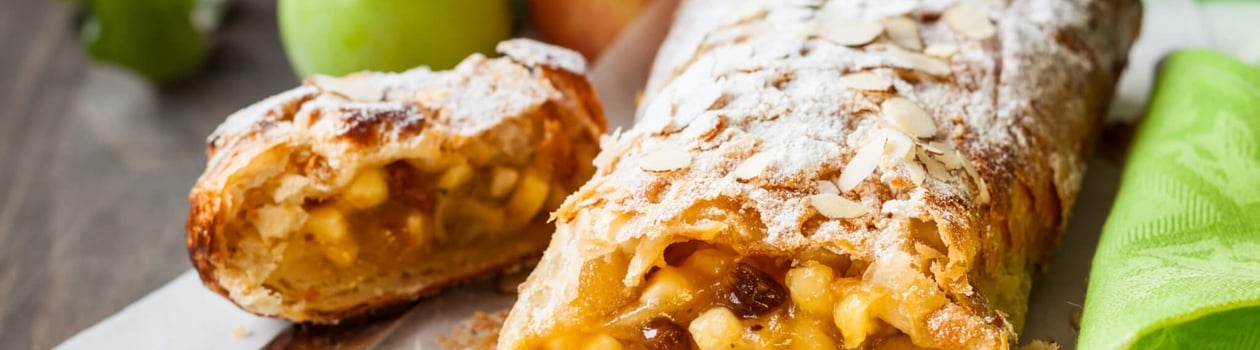
Apple Strudel is a tasty, fruity treat that provides a base of yummy dough surrounding naturally sweet apples. It’s a delightful dish that is often eaten as a dessert but some people certainly cheat and also enjoy it as a breakfast pastry.
According to some people, every day should be ‘apfelstrudel’ day–to give it its proper Austrian name. No matter what it is called, it’s time to learn about and celebrate National Apple Strudel Day!
How to Celebrate National Apple Strudel Day
Get excited about National Apple Strudel Day with some of these activities or coming up with other creative ideas:
Make Apple Strudel at Home
When creating this dish, the layers need to be worked until they are thin enough to read through. Now that’s thin! This dessert can be easy to create at home, using layers of buttered filo pastry or puff pastry, wrapped around layers of stewed apples.
The easiest apple strudel recipe will likely use a premade, refrigerated puff pastry dough, instead of having to make up and roll out the yeast dough at home. Once the premade puff pastry is secured, getting a few apples peeled, sliced, and prepared is actually pretty easy.
Of course, those who are feeling more adventurous and want to challenge their inner pastry chef can certainly start with a yeast recipe to roll out their own flaky, layered dough. In any case, it is sure to make a delectable treat.
Enjoy an Apple Strudel in Vienna, Austria
There can probably be no better place to truly enjoy an apple strudel than in a bakery right in the center of Vienna, Austria. In these Viennese bakeries, it’s not just a pastry, it is culinary art:
- Cafe Landtmann. Located in an exquisite hotel in Vienna, this Patisserie has grown up since the 1970s and is dedicated to handcrafting all of their pastries, including, of course, the classic apple strudel.
- Schönbrunn Palace’s Café Residenz. The ultimate visit to Vienna would include this show that takes place in the imperial bakery where, every hour, a professional pastry chef offers a demonstration of making apple strudel, along with tasting (including coffee, of course).
- Kaffee Alt Wein (Cafe Old Vienna). Enjoy authentic Viennese decor and ambiance in this cozy cafe. Located in the Old University Quarter, this cafe was founded in 1922 and has been a family business almost the entire time, since 1939. Don’t forget to pair a slice of apple strudel with their classic Viennese coffee blend that was developed almost 100 years ago.
Channel those Inner Austrian Roots
Just because a person can’t exactly travel to Vienna to pop into a little bakery doesn’t mean they can’t enjoy the day!
In an effort to celebrate the Austrian culture that brought apple strudel into the world, why not celebrate National Apple Strudel Day by donning lederhosen, practicing some yodeling, and settling down to a warming plateful with a mug of hot chocolate on the side?
Along those lines, go ahead and enjoy a meal of WienerSchnitzel and end it with Apple Strudel and, of course, a cup of Viennese coffee (espresso).
Watch A Strudel Inspired Film
Take a peek at these movies and make a game of enjoying the scenes that encompass Apple Strudel:
- Inglourious Basterds. This Quentin Tarantino film has viewers on the edge of their seats as the protagonist sits down for an apple strudel with her enemy and he insists that they must wait for the cream.
- Winter in Vail. This Hallmark Channel film features Lacey Chabert as an event planner who quits her job and moves to a chalet in Vail where she meets an attractive man who teaches her how to make apple strudel for a local event called the Strudel Fest. The storyline might be improbable but the strudel is still delicious.
- The Illusionist. Set in Vienna, a scene in this film depicts Edward Norton as a magician who is trying to win the heart of Jessica Biel, who plays a duchess. The two don’t technically share an apple strudel together–but is it wrong to wish they would? They are in Vienna, after all.
- Fantastic Beasts and Where to Find Them. This conversation says it all: Queenie asks Newt if he prefers pie or strudel. Newt replies that he has no preference, so Queenie corrects him and says, “You prefer strudel, huh, honey? Strudel it is.” Queenie must have known that it was National Apple Strudel Day, even in their fictitious world!
National Apple Strudel Day Timeline
First Recorded Strudel Recipe in Vienna
A handwritten recipe for milk‑cream strudel, regarded as the oldest known strudel recipe, was created and preserved in Vienna’s municipal library collections, establishing the dish in written culinary tradition.
Strudel Spreads Through the Habsburg Empire
Strudel pastries, including early apple-filled versions, gained wide popularity across the Habsburg territories, helping to fix layered, rolled pastries as a hallmark of Central European cuisine.
“Apfelstrudel” Enters a Major Viennese Cookbook
A detailed recipe titled “Apfelstrudel” appears in Anna Dorn’s Great Viennese Cookbook, documenting apple strudel as a distinct and codified dessert in Viennese home and professional kitchens.
Apple Strudel Becomes a Viennese Café Staple
As Viennese coffeehouse culture flourishes, apple strudel emerges as one of the most popular pastries served with coffee, reinforcing its image as an everyday yet emblematic treat of the city.
Strudel and the Intellectual Coffeehouse Scene
In fin‑de‑siècle Vienna, cafés frequented by writers, artists, and political thinkers commonly offered apple strudel, tying the pastry to the social and intellectual life that later earned coffeehouse culture UNESCO recognition.
From Imperial Dessert to Central European Classic
Through political change and migration after the fall of the Austro‑Hungarian Empire, apple strudel became a shared classic across Austria, the Czech lands, Hungary, and neighboring countries, each adopting local variations.
Globalization of Apple Strudel
Tourism, international cookbooks, and café chains spread apple strudel far beyond Central Europe, making the Viennese pastry a familiar dessert from London to North America while preserving its thin dough and spiced apple filling as defining features.
History of National Apple Strudel Day
A dish that probably dates back to medieval times, Apple strudel consists of a center of apple slices, cinnamon, sugar and (sometimes, but not always) raisins.
These ingredients are wrapped in crispy layers of pastry that puff up when baked in the oven. Often served with a dusting of powdered sugar and a dollop of thick cream, the apple strudel is a delicious display of comfort food at its finest.
Although many people think that this sweet dish comes from German origins, apple strudel is actually an Austrian food, hailing from Vienna. In fact, the original recipe for apple strudel, dated 1697, was handwritten in a Viennese cookbook and still survives today, in the Vienna Town Hall Library.
After its first recording, the dessert gained popularity throughout the Austro-Hungarian empire in the 18th century, making it an icon of the culture.
However, due to the paper-thin layers of dough, it is actually possible that the recipe may have some influences from places further east, such as Turkey or possibly Greece (think baklava).
The German language meaning of strudel is “whirlpool”, “vortex” or “eddy”, which aptly describes the way the pastry layers tend to circle the filling.
Many varieties of this traditional dish have come into play over the years. In fact, nearly every family in Austria has its own particular recipe for apple strudel! Today, different types of strudel are eaten, including cheese strudel, apricot strudel, poppy seed strudel or even a savory strudel made with spinach.
All of these varieties are likely fun and delicious adventure, but they always point back to the iconic classic that is celebrated on this day: National Apple Strudel Day.
Bonus: Easy Apple Strudel Recipe
Try out this simple recipe:
- 3 Apples (Granny Smith or other tart apples) peeled and sliced ¼ inch thick
- 1 cup light brown sugar
- 1 tsp vanilla
- 1 tsp lemon juice
- 1 tsp cinnamon
- 3 Tbsp flour
- ½ cup raisins (if preferred)
Mix these ingredients together in a bowl and stir just until evenly coated. Spread puff pastry out on a baking sheet and place apple mixture in the center (lengthwise).
Fold the dough over the filling and press the edges together (use water as needed). Brush the top with an egg wash (1 egg and ¼ cup milk) and sprinkle with coarse sugar. Bake at 350 degrees F for 35-40 minutes.
Voila! Delicious apple strudel with very little work. Serve with a dollop of custard, whipped cream or vanilla ice cream. Share with family and friends in honor of National Appple Strudel Day.
National Apple Strudel Day Facts
Imperial Roots in a 17th‑Century Viennese Manuscript
The earliest known written recipe for a strudel-style apple pastry appears in a late 17th‑century manuscript preserved at the Vienna City Library (Wienbibliothek im Rathaus).
Dated around 1696, it records a milk‑cream and apple strudel made for the Habsburg court, showing that refined filled pastries were already part of elite Viennese cuisine before they became everyday coffeehouse fare.
From Ottoman Baklava to Central European Strudel
Food historians trace strudel’s paper‑thin dough technique to the influence of Ottoman pastries such as baklava, which spread into Central Europe during centuries of Habsburg‑Ottoman contact.
As cooks in Hungary and then Vienna adopted and adapted these layered sweets, they replaced nut-and-honey fillings with local ingredients like apples, helping create the distinct Central European strudel tradition.
Paper‑Thin Dough as a Test of Skill
Traditional strudel dough is kneaded until highly elastic, rested, and then stretched by hand over a table until it is almost transparent, often reaching around 30 by 30 inches for a single pastry.
Culinary schools in Vienna and abroad still teach that a hallmark of craftsmanship is dough thin enough to read print through, a standard that distinguishes true strudel from shortcuts made with puff pastry.
Why Buttered Breadcrumbs Hide Inside Authentic Strudel
Many classic apple strudel recipes include an inner layer of breadcrumbs browned in butter beneath the apple filling.
This seemingly odd addition serves a practical purpose: the crumbs soak up excess juice from the apples as they bake, preventing the ultra‑thin dough from becoming soggy and helping keep the pastry crisp and sliceable.
A Pastry at the Heart of UNESCO‑Listed Coffeehouse Culture
Viennese coffeehouse culture is recognized by UNESCO as intangible cultural heritage, and apple strudel is one of the pastries most closely associated with this tradition.
Tourist and cultural guides describe how guests linger over newspapers, strong coffee, and slices of strudel served with whipped cream or warm vanilla sauce, making the dessert part of a long‑standing social ritual rather than just a quick sweet.
How Strudel Became a Jewish Kitchen Staple
Strudel, including apple-filled versions, was adopted into Ashkenazi Jewish cuisine across the Habsburg lands, where Jewish bakers learned and adapted local pastry techniques.
Recipes in Jewish cookbooks often replace butter with oil or other pareve fats so the dessert can be served after meat meals under kosher rules, showing how a regional imperial specialty was reshaped to fit religious dietary law.
Alpine Apples and Italian “Strudel di Mele”
In northern Italy’s Trentino‑Alto Adige/Südtirol region, once part of the Austro‑Hungarian Empire, apple strudel has become a local signature dessert known as strudel di mele or apfelstrudel.
Bakers there typically use regional PDO and PGI apples from the Alpine valleys, along with raisins and pine nuts, illustrating how a Viennese pastry was localized using Italian-protected apple varieties and regional tastes.
National Apple Strudel Day FAQs


You may also like

National Cookie Dough Day
Unbaked delight with a mix of sweetness and texture, a culinary temptation awaiting the oven's transformative touch.
- Australia
- Canada
- United Kingdom
- and 1 more
Apple Tree Day
Experience the joy of picking your own fruit straight from nature's bounty and enjoy a sweet treat that's truly farm-to-table.
- Australia
- Canada
- United Kingdom
- and 1 more
National Apple Pie Day
The American classic, a staple of holiday dinners and grandma’s cooking. Try your hand at making your own Apple pie, or visit a diner or bakery and indulge.
- United States
National Eat A Red Apple Day
Eat a Red Apple Day shines brightly during this winter season, inviting everyone to bite into the juicy, health-packed fruit! This day isn't just about savoring one of nature's sweet treats. It's a nudge to remember the goodness apples can bring into everyone's daily life. Rich in vitamins, minerals, and antioxidants...
- Australia
- Canada
- United Kingdom
- and 1 more
National days and holidays on June 17

National Thank a Teacher Day
Celebrate National Thank a Teacher Day by honoring teachers and school staff with gratitude, messages, and nominations that recognize their vital impact.
- Canada
- United Kingdom
- United States

Bunker Hill Day
Discover the history and meaning of Bunker Hill Day, honoring courage, community, and the Revolutionary War battle that helped shape American identity.
- United States

National Mascot Day
National Mascot Day honors the fun, energetic characters who boost team spirit, entertain crowds, and build community pride on and off the field.
- United States

World Day to Combat Desertification and Drought
Discover the World Day to Combat Desertification and Drought, raising awareness on land degradation, water scarcity, and sustainable solutions for a healthier planet.
- Afghanistan
- China
- United States
Seize Every Day
Join free for personalised recommendations, email reminders and exclusive guides. Never miss a day.