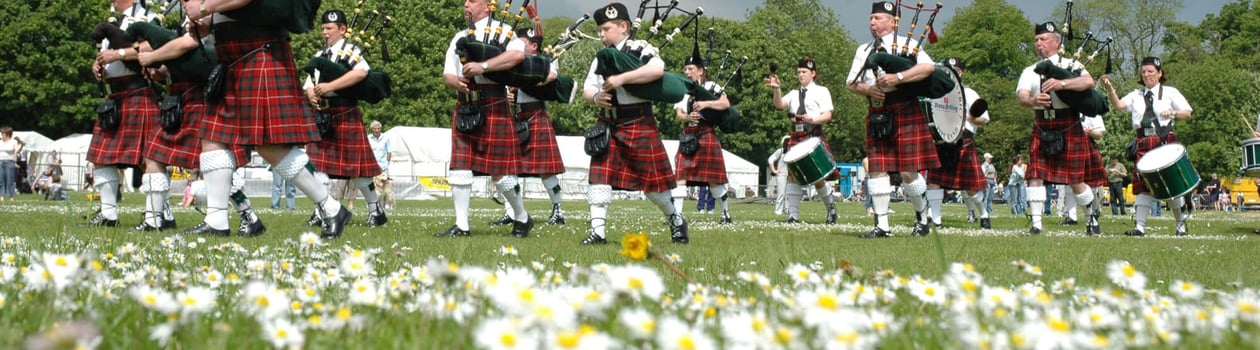
The sound of bagpipes filling the air as day dawns is enough to bring joy to the hearts of many. Others, they may not feel quite the same.
It seems that one either loves the pipes or not at all. There is not very much middle ground. International Bagpipe Day is the time to find out where you stand and join those who love them!
How to Celebrate International Bagpipe Day
Celebrating the bagpipe when this holiday rolls around can take many forms. If you have ever wanted to try your hand at it, don’t wait! This is the time for you to find your local provider of the pipes and take a lesson. You could be the next great Piper! It could happen, you never know, right?
There is a multitude of information available about this instrument. A great idea to celebrate is to learn more about it.
A quick internet search will bring up resources like The Bagpipe Society. You can follow the history of this unique instrument through the millennia to present day and from country to country! There is much more information than you could learn in just one day, but it’s a great time to start.
Another way to celebrate is to find out if there are any events planned in your local area. Grab the family or friends and go check it out! You may just find that you were missing out on all the fun. If you ask, it may even be possible to try it out and see if you can make a sound with it!
Bagpipes have a long history that spans the ages and spans many regions. It is an instrument that has weathered the test of time and surely deserves to be honored on International Bagpipe Day!
History of International Bagpipe Day
The International Bagpipe Organisation and the Bagpipe Society co-founded the celebration of International Bagpipe Day in 2012.
They have helped to bring the bagpipe to new players since 1986. It is important to them that the history and playing of the bagpipes are not lost. Putting this day together was with the hope of bringing awareness of the over 130 different types of bagpipe throughout the world.
For the first International Bagpipe Day in 2012, there were reports of events held in some unique places. In South Africa, pipers gathered and played in an underground canyon. In Greece, they played on Athenian hill.
The Society even heard of events in countries where previously it was thought that there were not many pipers or any at all!
If you aren’t familiar with this ancient instrument, bagpipe is a term that means a wind instrument that uses enclosed reeds to produce sound.
Air feeds the reeds with a constant flow of air from a reservoir in the form of a bag. In each area that it is found, the bagpipe may change in sound and shape. This is an ancient instrument and is claimed to be represented on a Hittite slab dated to 1000 BC!
The Powerful Sound and Ancient Story of Bagpipes
From their unmistakable volume to their ability to play continuously, bagpipes are far more complex than they first appear.
These fascinating instruments combine clever engineering, ancient history, and a sound designed to carry across great distances.
The following facts explore what makes bagpipes so loud, how they sustain their signature tone, and just how far back their origins may reach.
Air Pressure Makes Bagpipes Unusually Loud
Bagpipes are among the loudest acoustic instruments because their reeds are driven by steady, relatively high air pressure from the bag, not by the lungs alone.
Great Highland bagpipes typically reach average sound levels around 95–111 decibels at the player’s ear, comparable to a motorcycle or chainsaw, which is why modern players are often advised to use hearing protection during practice and performance.
Why Bagpipes Can Play Almost Non‑Stop
The signature “wall of sound” produced by bagpipes comes from their closed‑end chanter reeds and continuously fed drones.
Unlike many woodwinds, the air reservoir in the bag allows a piper to maintain tone while breathing, so the vibrating reeds almost never stop.
This continuous excitation also means the sound spectrum is rich in high‑frequency components, contributing to the penetrating, carrying quality that makes pipes audible over long distances and in outdoor settings.
Hittite Carving Suggests Very Early Bagpipes
One of the earliest possible depictions of a bagpipe‑type instrument appears on a stone relief from the ancient Hittite city of Euyuk in modern‑day Turkey, dated to around 1000 BCE.
The carving shows a figure apparently playing a wind instrument attached to a bag held under the arm, which many music historians interpret as evidence that bagpipe‑like instruments existed in the Eastern Mediterranean over two millennia before their association with Scotland.
Ancient Greeks Had a “Wineskin Pipe”
Classical sources indicate that the ancient Greeks used a bagpipe‑like instrument known as the askavlos or askaulos, literally “wineskin pipe.”
Writers such as Dio Chrysostom in the first and second centuries CE mention a piper playing on a skin bag, and later Byzantine texts also refer to similar instruments, suggesting a long, continuous Mediterranean tradition of bagpipe‑style music predating medieval European examples.
Bagpipes Once Served Roman Soldiers
Literary and later historical accounts suggest that the Romans used bagpipes in military and public life, particularly among common people and foot soldiers.
Emperor Nero is described by the third‑century writer Suetonius as performing on a type of pipe with a bag, and other sources refer to bag‑equipped wind instruments used by infantry while cavalry still relied on trumpets, highlighting how bagpipes functioned as practical loud instruments for marching troops.
Britain’s Empire Helped Globalize Highland Pipes
While bagpipe traditions already existed in many regions, the Great Highland bagpipe spread widely during the 18th and 19th centuries through the British Army.
Highland regiments stationed in places such as India, the Middle East, southern Africa, and the Caribbean took their military pipe bands with them, and archival material from the British War Office shows that by the late 1800s, pipers were formally recognized in numerous imperial garrisons, influencing local musical cultures and ceremonial practices.
There Are Far More Bagpipe Traditions Than Most People Realize
Organological surveys by the International Bagpipe Organisation and European folk‑music researchers have documented well over 100 distinct bagpipe types across at least 40 countries.
Beyond the well‑known Scottish and Irish instruments, there are Bulgarian kaba gaida, Spanish and Portuguese gaitas, Italian zampogne, Greek tsampouna, North African mizwad, and Indian mashak, each with its own tuning system, scale patterns, and social role in rituals, dance, or pastoral life.