
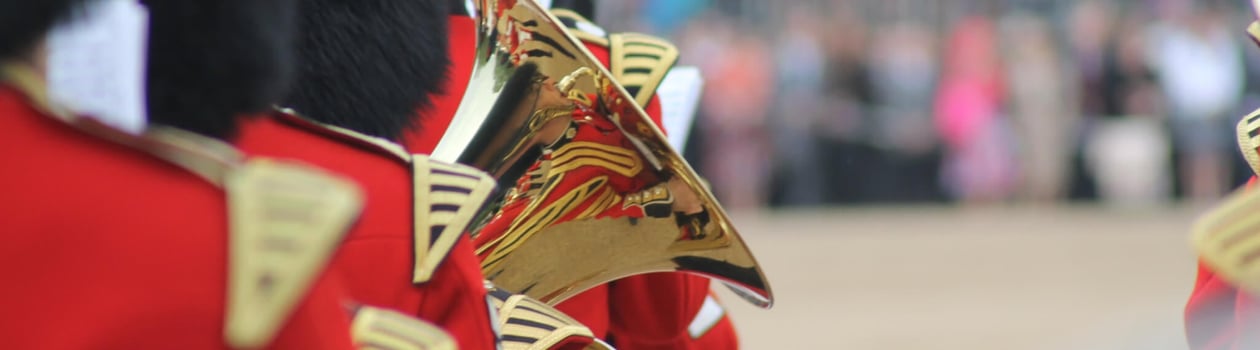
For more than two centuries, the United Kingdom has marked Trooping the Colour with a remarkable display of military choreography, polished brass, and enough tradition to make even a seasoned parade-goer sit up straighter.
Officially known as the King’s Birthday Parade (or the Queen’s Birthday Parade when the sovereign is female), it celebrates the monarch’s official birthday with a formal review of the monarch’s own guards, culminating in the ceremonial “trooping” of a regimental color through the ranks.
Although it is often spoken about as a birthday celebration, the ceremony is not generally tied to the monarch’s actual birth date. Instead, it is traditionally staged at a time of year suited to outdoor pageantry, when uniforms, horses, and instruments have a better chance of staying dignified from start to finish.
How to celebrate Trooping the Colour
Trooping the Colour can be enjoyed in person, watched from afar, or used as an excuse to stage a little pomp and pageantry at home. The key is to lean into what the day does best: tradition, music, military precision, and a bit of theatrical sparkle.
For those attending in person, there are typically two main viewing styles: seated viewing at Horse Guards Parade and public viewing along parts of the route, such as The Mall. Seated tickets are generally limited and commonly distributed via a ballot system, which means planning ahead matters.
For those who prefer not to navigate ticketing, watching from public areas can still be memorable. The atmosphere tends to be festive but orderly, with spectators arriving early to claim sight lines and settle in for the procession and its return.
What to wear can be part of the fun, especially because Trooping the Colour has an unmistakably formal personality. Some official viewing areas have dress codes that favor smart attire over casual clothing. Even for those who are not required to dress up, choosing something neat and comfortable can make the day feel more like an occasion and less like any other outdoor event.
For viewers watching on television or via official broadcasts, the ceremony becomes a front-row seat to details that can be hard to catch in a crowd: the synchronized footwork, the way formations change shape, the musicians’ cues, and the moment when the Colour is carried through the ranks.
A good way to celebrate from home is to watch with the sound up, since the music and commands are essential to understanding what is happening. It is also a surprisingly satisfying event for anyone who enjoys craftsmanship, from uniform tailoring and polished metalwork to the training that makes thousands of small movements align.
A simple, globally accessible way to mark Trooping the Colour is to make it an at-home “parade day.” That might include setting up a viewing spot, preparing refreshments, and treating the broadcast like a special performance.
Families sometimes enjoy turning it into a mini cultural exploration: identifying the different units, noticing the contrast between foot guards and mounted troops, and spotting the shift from slow to quick time. Even without expert knowledge, the structure is clear enough to follow, and the spectacle is easy to appreciate.
For those who like to celebrate with a social element, a viewing gathering can work well because the ceremony has natural chapters. There is time to chat during the build-up, then moments that reliably hush a room, like the formal salute, the trooping of the Colour, and the march-past. It is a rare event that can entertain history lovers, music fans, and people who simply enjoy seeing a large group do something flawlessly together.
Another meaningful way to celebrate is to learn what “Colours” represent beyond the fabric itself. Regimental Colours traditionally carry battle honors and symbols of unit history. Reading about why flags mattered on the battlefield, and why they are treated with such reverence in ceremonies, makes the central moment far more than a pretty flourish. Suddenly, the slow, careful movement of the Colour through the ranks feels like an echo of something older and more serious, preserved in a safe modern setting.
Music lovers can also make Trooping the Colour a reason to explore military band traditions. The Massed Bands are not just there for volume. Their performance requires its own discipline, and many marches and ceremonial pieces are arranged specifically to match marching pace and the needs of a formal parade. Even without naming every tune, listeners can pay attention to how the music signals changes: how it builds during movement, steadies during inspection, and sharpens when the tempo increases.
Photography and sketching can be another form of celebration, particularly for those who appreciate design. The event offers striking contrasts: scarlet uniforms against pale stone, polished helmets catching light, horses in motion, and tight blocks of soldiers forming patterns across an open square. For anyone not attending in person, pausing a broadcast to capture a quick sketch of formations or uniform details can turn passive watching into a creative activity.
Finally, Trooping the Colour can be celebrated simply by embracing its spirit: orderly spectacle, respect for tradition, and a shared public performance that turns military history into a living ritual. Whether someone watches from the edge of the route, tunes in from another time zone, or hosts a small gathering with a homemade sense of ceremony, the day offers an unusually vivid invitation to enjoy pageantry with purpose.
What happens during the Trooping the Colour ceremony?
Trooping the Colour is a tightly structured event, designed to look effortless while requiring enormous coordination. It is held on Horse Guards Parade, the large ceremonial ground associated with the Household Division. The parade includes more than 1,400 soldiers, around 200 horses, and roughly 400 musicians, all operating as if they share one mind, one tempo, and one set of perfectly polished boots.
The day’s visual story usually begins with the royal procession traveling from Buckingham Palace along The Mall to Horse Guards Parade. The sovereign is escorted by mounted troops, and other members of the royal family may appear in the procession as well, either on horseback or in carriages, depending on custom and circumstance. It is ceremonial, but it is also functional: the procession is part of the “review,” bringing the sovereign to the troops who will be inspected.
On arrival at Horse Guards Parade, the monarch is greeted with a Royal Salute. This is not a casual wave and a smile. It is a formal exchange of military honors, performed with the kind of exactness that makes spectators suddenly aware of how casually most people stand. Around the same time, a gun salute is fired by the King’s Troop Royal Horse Artillery, often associated with nearby ceremonial spaces, adding a thunderous punctuation to the proceedings.
Next comes the inspection, one of the most meaningful parts of the event. The sovereign inspects the troops drawn up on the parade ground, viewing uniforms, arms, and the general readiness of the assembled units.
This echoes the historic duty of a monarch as commander-in-chief, though in modern life it functions as symbolic continuity. The troops are not simply “on display.” They are formally reviewed, just as they would be in a professional military setting.
Music is not background decoration here. The Massed Bands, Corps of Drums, and other musicians perform as an integral part of the ceremony, shaping its pace and signaling transitions. The sound of massed military bands can be surprisingly physical. It does not just fill the air; it defines it, turning a wide open parade ground into a kind of musical architecture.
The central act, the one that gives the day its name, is the trooping of the Colour. One of the Foot Guards regiments is selected to have its regimental Colour “trooped” that year. The Colour is carried and formally presented, moved through the ranks so that every soldier on parade can see it. The careful handling of the Colour reflects its historical importance. It is not waved about for drama. It is carried with strict discipline, and it is saluted with great respect.
After this, the parade moves into the march-past. The troops pass the sovereign in formation in both slow and quick time, demonstrating precision, unity, and control. During the slow march-past, the Colour is lowered in respect to the monarch, and the monarch returns the salute.
In quick time, the Colour is carried high, and the whole scene shifts from solemn grandeur to energetic spectacle. The cavalry elements also perform their own pass, including mounted movements that add speed, scale, and rhythmic thunder to the foot soldiers’ crisp patterns.
Once the troops have marched past, the ceremony transitions into the return. The sovereign departs Horse Guards Parade and travels back to Buckingham Palace, escorted by the guards. Crowds line the route not just to see a royal figure go by, but to watch the moving geometry of the parade itself: mounted troops maintaining spacing, foot guards holding lines, and musicians keeping time even as they move through public streets.
At Buckingham Palace, the final act is lighter in mood but still formal. The royal family appears on the balcony to observe a flypast by the Royal Air Force. This moment has its own distinct character. It shifts attention from the historic symbols on the ground, the Colour, the guards, the horses, to the modern symbols in the sky. The flypast provides a fitting capstone: loud, fast, and unmistakably contemporary, while still rooted in ceremonial tradition.
Taken as a whole, Trooping the Colour is not a random assortment of impressive moments. It is a carefully layered narrative: procession, salute, inspection, music, the trooping itself, and the march-past, followed by a return and a finale. Each piece has a purpose, and together they create the sense of continuity that draws audiences year after year.
Trooping the Colour Timeline
Early Military Standards as Rallying Points
Armies in ancient Egypt and other early civilizations used poles, emblems, and animal figures as battlefield standards so soldiers could recognize their leaders and rally amid dust and confusion. [1]
Heraldic Banners Formalize Command Symbols
European knights and commanders begin to carry heraldic banners bearing coats of arms, turning personal symbols into recognized command standards that organize feudal armies in the field.
British Regiments Adopt Multiple Company Colours
In the developing standing army of Britain, infantry regiments commonly carried many colors, often one per company, displaying the colonel’s arms and serving as visual markers for troops during battle.
Royal Warrants Standardize British Regimental Colours
Orders issued under King George II reduced British infantry colors to a regulated pattern of two per regiment, distinguishing a royal flag and a regimental flag and laying the basis for later ceremonial drill. [1]
Battle Honours Added to Regimental Colours
A Royal Warrant confirms the Union Flag as the sovereign’s colour and allows battle honours to be emblazoned on regimental colours, deepening their role as symbols of collective memory and sacrifice. [1]
Defence of the Colours at the Battle of Albuera
In the Peninsular War, British troops fight desperately to save their colours at Albuera, illustrating how flags function as focal points of courage and identity long after their practical battlefield role declines. [1]
British Ceremonial Drill Manual Codifies Trooping Movements
A postwar ceremonial drill manual formally sets out the precise slow- and quick-time movements for trooping the colour, preserving earlier battlefield practices in detailed parade-ground choreography. [1]
History of Trooping the Colour
Trooping the Colour began as something practical long before it became spectacular. The word “colour” does not mean a shade on a paint card. In military terms, a “Colour” (often used in the plural as “Colours”) is a regiment’s flag. Historically, these flags served as highly visible rallying points in battle.
When the field was smoky, chaotic, and loud enough to drown out shouted orders, soldiers looked for their regiment’s Colours to find their place, keep formation, and regroup if scattered. Losing a Colour to the enemy was a serious disgrace; protecting it was a matter of pride and identity.
The ceremony is most strongly associated with the reign of King Charles II (1660–1685), when versions of trooping a Colour were performed as a military custom. Regiments would “troop” the Colour, meaning the flag would be carried slowly along the line so that every soldier could see it clearly and recognize it. This was, in effect, a rehearsal for recognition, loyalty, and coordination.
In 1748, the practice took on a new layer of meaning when it was decided that Trooping the Colour would be used to mark the sovereign’s official birthday. What had been a professional military routine became a public-facing expression of the bond between the Crown and the armed forces.
Over time, it settled into the role it still holds: a ceremonial review in which the sovereign’s troops parade in full dress and present their standards, precision, and discipline for inspection.
Trooping the Colour is performed by the Household Division, the units traditionally tasked with protecting the monarch. This includes the Foot Guards, famous for their scarlet tunics and tall bearskin caps, and the Household Cavalry, mounted and magnificent. The regimental Colour at the heart of the ceremony rotates among the Foot Guards regiments. That rotation keeps the tradition living rather than museum-still, and it also ensures that each regiment’s identity and honors receive their turn in the spotlight.
While the event is rooted in battlefield necessity, its modern purpose is ceremonial rather than tactical. It preserves a working vocabulary of military heritage: the disciplined forms of marching, the salutes, the music, the careful handling of the Colour, and the clear chain of command that guides each movement. In that sense, Trooping the Colour functions like a public drill book brought to life, with historical meaning carried in every measured step.
Trooping the Colour Facts
Living Battle Maps Embroidered in Silk
British regimental colours are not just flags but densely embroidered “maps” of a unit’s combat history, often carrying dozens of battle honours that can take months of handwork to add.
The National Army Museum notes that each stand of colours (the King’s/Queen’s Colour and the Regimental Colour) records major battles and campaigns in gold lettering and intricate wreaths, so that a single piece of silk can summarize more than a century of a regiment’s service.
From Company Flags to a Single Stand of Colours
In the 17th century, each company within a British infantry regiment carried its own colour, which meant a single regiment could field up to ten separate flags in battle.
By the early 18th century, this was reduced to three per regiment, and after the pike was abolished in 1707, the system was streamlined again to just two colours per regiment, a pattern later formalized by a Royal Warrant in 1743 and still recognizable in modern British Army practice.
Why British Infantry Traditionally Wore Red
The famous scarlet worn by British Foot Guards grew out of practical decisions as much as pageantry.
Military historians point out that red dyes based on madder were relatively cheap and available when the New Model Army adopted red coats in the 1640s, and the strong color helped units recognize one another through the smoke of black‑powder battles.
Those utilitarian choices later hardened into a powerful visual symbol of royal authority and professional soldiery in British ceremonial dress.
How to “Read” a Guardsman’s Tunic
On a Foot Guards tunic, even the spacing of the buttons signals regimental identity to those who know the code.
The Grenadier Guards have single evenly spaced buttons, the Coldstream Guards use pairs, the Scots Guards group them in threes, the Irish Guards in fours, and the Welsh Guards in fives, mirroring the order in which the regiments entered service and allowing officers and soldiers to identify a unit at a glance on parade.
The Evolving Role of Foot Guards Regiments
Today, the five Foot Guards regiments are best known for ceremonial duties, but historically, they were elite line units expected to fight as well as guard the sovereign.
Sources like the Guards Museum and official histories trace origins back to mid‑17th‑century formations such as the Coldstream Guards and the regiment that became the Grenadier Guards, which saw heavy action in campaigns from the War of the Spanish Succession to Waterloo before their public image shifted toward state ceremony in the Victorian era and beyond.
Why Horse Guards Parade Became London’s Ceremonial Stage
Horse Guards Parade, today a broad gravel expanse off Whitehall, began as the tiltyard of Whitehall Palace, where Tudor and Stuart monarchs staged tournaments.
After the Restoration in 1660, mounted guards for the king used the area, and by the mid‑18th century, it had evolved into a formal parade ground framed by the Horse Guards building.
Its central position between royal palaces and government offices helped fix it as the natural backdrop for major military ceremonies in London.
Why Colors Became Sacred Objects to Regiments
Because colours once marked the physical heart of a regiment on chaotic battlefields, they acquired a near‑sacred status in British military culture.
The National Army Museum records multiple actions in which officers and sergeants were killed or wounded trying to save their colours from capture, and retired colours are often laid up in churches or regimental chapels rather than destroyed, reflecting a belief that the flag embodies the regiment’s collective identity and the sacrifice of its soldiers.
Trooping the Colour FAQs
Why were military colors so important on historical battlefields?
Military colors, or regimental flags, once had a vital practical role in battle.
In the noise, smoke, and confusion of combat, soldiers could not rely on shouted orders or modern communications, so they used their colors as a visible rallying point to find their own unit, locate senior officers, and dress their lines.
Losing a color to the enemy was seen as a deep disgrace, while saving or capturing colors could become a celebrated act of heroism, which is why they later became powerful symbols of honor and identity even after their battlefield use ended. [1]
What do the different British Army regimental colors represent today?
In the British Army, an infantry battalion usually carries two main colors.
The King’s (or Queen’s) Colour is based on the national flag and represents loyalty to the reigning monarch, while the Regimental Colour typically uses the regiment’s own facing colour and bears its badge and selected battle honors from past campaigns.
Together, they act as a physical record of a unit’s service and traditions and are treated as treasured objects that embody the regiment’s history and identity. [1]
Who are the Foot Guards and why do they have a prominent ceremonial role?
The Foot Guards are five infantry regiments of the British Army’s Household Division: the Grenadier, Coldstream, Scots, Irish, and Welsh Guards.
They are fully trained operational soldiers who can deploy on military duties, but they are also closely associated with state ceremonial.
Their responsibilities include guarding royal palaces and taking part in major public events, which places them at the center of many high-profile occasions involving the monarch.
What is the Household Division in the context of the modern British Army?
The Household Division is a formation in the British Army that provides both ceremonial and protective duties for the monarch while remaining part of the Army’s regular fighting strength.
It includes the Foot Guards and the Household Cavalry, whose soldiers guard royal residences, mount public duties in London and Windsor, and appear at major state events.
At the same time, its units train and deploy on operations like other Army forces, so the same regiments seen in ceremonial dress may also serve on active service overseas. [1]
What purposes do large state and military parades serve in the 21st century?
In the 21st century, large state and military parades mainly serve symbolic rather than operational purposes.
They display discipline, training, and continuity within institutions such as the armed forces and the head of state.
For the military, precise drill and coordinated movement help build unit cohesion and pride, while for the wider public, these parades act as shared civic rituals that can support tourism, international visibility, and a sense of national identity.
How do other constitutional monarchies use their armed forces in public ceremonies?
In many constitutional monarchies, the armed forces play a visible role in ceremonies that mark national or royal occasions, although customs differ between countries.
In the Netherlands, for example, the military participates in events such as Prinsjesdag and ceremonies involving the monarch, while in Norway and Sweden, guard units provide honor guards and parades on national days and royal milestones.
In each case, the emphasis is on loyalty to the head of state, continuity of the constitution, and public display of military professionalism rather than on combat functions.
Why do regimental colors still appear in ceremonies if they are no longer used in combat?
Although colors are no longer carried on modern battlefields, they continue to feature in ceremonies because they have become repositories of regimental memory.
Over time, they acquire battle honors, royal associations, and stories of sacrifice, and they are treated with a formality that reflects that history.
National and regimental museums preserve retired colors, and serving units use ceremonial parades to present, display, or lay up colors as a way of linking current soldiers with earlier generations.



You may also like

King’s Birthday
Discover the history, traditions, and modern celebrations of the King’s Birthday, from royal parades to community events across Commonwealth countries.
- Australia
- Canada
- New Zealand
- and 1 more

Army Birthday
Honor the legacy and service of the U.S. Army, from its 1775 founding to today, with traditions, ceremonies, and ways to thank soldiers on Army Birthday.
National Borinqueneers Day
National Borinqueneers Day honors the brave Puerto Rican soldiers of the 65th Infantry Regiment. Known as the Borinqueneers, these men served valiantly in various conflicts, including the Korean War. Their dedication and courage earned them numerous accolades, such as the Congressional Gold Medal. This day highlights the significant contributions of Hispanic...

Western Monarch Day
Witness the graceful dance of vibrant winged creatures as they flutter through the air, bringing a touch of enchantment to the natural world.
National days and holidays on June 13
Vivid Sydney
Vivid Sydney is a dazzling celebration that transforms the city into a vibrant playground of lights, music, and creativity. For weeks, iconic landmarks and urban spaces glow with stunning light installations and 3D projections, captivating both locals and tourists. This festival draws millions of visitors each year, offering an enchanting...

World Gin Day
Raise a glass to World Gin Day, celebrating juniper spirits with tastings, cocktail events, history, and creative ways to enjoy gin responsibly worldwide.
- Australia
- Canada
- United Kingdom
- and 1 more
Feast of St. Anthony
Discover the Feast of St. Anthony, honoring the beloved saint with blessed bread, prayer, charity, and community celebrations rooted in faith and hope.

National Weed Your Garden Day
Celebrate National Weed Your Garden Day by pulling pesky weeds, refreshing beds, and nurturing healthier, more beautiful plants in any garden or container space.
Seize Every Day
Join free for personalised recommendations, email reminders and exclusive guides. Never miss a day.