Leaving behind familiar streets, family ties, and steady routines, the people now known as the Windrush Generation crossed the Atlantic to help rebuild a nation that was still shaking off the damage of World War II. Their labor kept buses moving, hospitals staffed, and factories humming, and their culture reshaped music, food, language, and everyday life in Britain.
Windrush Day commemorates Afro-Caribbean communities and others who arrived during this era, recognizing both their enormous contribution and the complicated realities they faced while building new lives.
How to Celebrate Windrush Day
Windrush Day is at its best when it is both joyful and thoughtful: a chance to celebrate Caribbean heritage and Black British history while also making room for honest conversations about belonging, fairness, and the meaning of “home.” Celebrating does not require a grand production. Small, well-chosen actions can be just as powerful.
Show some appreciation for those who come from the Windrush Generation by enjoying and celebrating the day in some of these ways:
Attend a Windrush Day Event
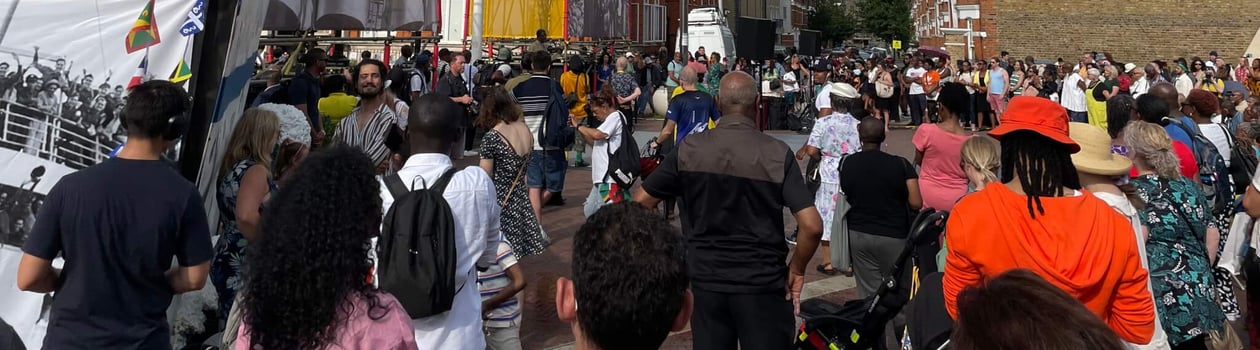
In many communities, Windrush Day programming tends to blend celebration with storytelling. Events may include live music, dance, poetry, film screenings, panel discussions, and exhibitions of photographs, letters, and everyday objects that capture the experience of arriving and settling. Some events lean into the “party with a purpose” feel: a steel pan performance followed by a talk with elders, or a community feast alongside a small archive display.
For anyone attending, it helps to arrive curious rather than rushed. Windrush Day events often feature oral histories or first-person reflections that can be easy to overlook if the crowd is focused only on entertainment. Taking time to read the captions, listen to short speeches, or watch a documentary segment can turn a pleasant outing into a genuine learning experience.
Those looking to participate more actively can volunteer on the day. Many community groups appreciate help setting up chairs, greeting guests, assisting elders, serving food, or helping children with crafts. Supporting behind the scenes is a practical way to honor the generations who did so much essential work that was often invisible.
Discover Windrush Connections
For people who suspect they have family ties to the Windrush Generation, Windrush Day offers a meaningful prompt to look more closely at personal history. That might include asking relatives about the first arrival in Britain, finding out which island a grandparent came from, or learning the names of ships, ports, and neighborhoods that became part of the family story.
Genealogy is not only about documents. Many Windrush stories live in memories, nicknames, and the kind of details that never appear on official forms: the first job, the first winter coat, the first room rented, the place where friends gathered to laugh and listen to music. Recording these details can be as valuable as locating a passenger list, especially because paperwork was not always consistently issued or preserved.
A practical way to begin is with a short family interview. Questions might include:
- What year did the move happen, and who came first?
- Where did the first arrivals live, and who helped them settle?
- What work did they do at first, and what changed over time?
- Which traditions stayed the same, and which ones evolved?
Community archives, museum collections, and local history projects can also provide context. Some institutions have gathered stories, photographs, and educational materials specifically to support Windrush Day and help people connect individual family narratives to the wider history of migration and settlement. Even without direct ancestry links, exploring these collections can help anyone understand how personal lives intersect with national history.
Learn About the Windrush Scandal
Windrush Day is also a time to grapple with a painful modern chapter: the Windrush scandal, which became widely known in 2018. For decades, many people who had legally settled in Britain found themselves asked to prove their status in ways that were difficult or impossible. Some had arrived as children on a parent’s passport, or had never been given formal proof of their right to live in the country. Others assumed that long residence, work history, and paying taxes were proof enough. Suddenly, they were required to produce documentation that many never had.
As immigration checks expanded into everyday life, people who could not easily prove their status were sometimes denied jobs, housing, healthcare, and benefits. Some were wrongfully detained. Some were removed from the country or threatened with removal. Beyond the immediate practical harm, many experienced deep emotional distress and a sense of betrayal, especially because many had spent most of their lives thinking of Britain as home.
Learning about the scandal can be done in a way that is informative rather than sensational. A thoughtful approach might include:
- Reading personal testimonies from those affected, focusing on the real-life consequences of policy decisions.
- Understanding how recordkeeping, changing laws, and bureaucratic assumptions contributed to people being misclassified.
- Discussing what fair treatment looks like when governments design systems that rely heavily on paperwork.
Windrush Day can hold more than one truth at once: pride in achievement and culture, gratitude for service and sacrifice, and a sober recognition that belonging should not be so easily questioned.
Windrush Day Timeline
Caribbean Service in World War II
Thousands of Caribbean men and women serve in the British armed forces, forging ties to Britain that later shape expectations of citizenship and postwar migration.
British Nationality Act 1948
Parliament passes the British Nationality Act, creating the status of Citizen of the United Kingdom and Colonies and confirming free entry and settlement rights for colonial citizens, including many future Windrush migrants.
Empire Windrush Arrives at Tilbury
HMT Empire Windrush docks at Tilbury Docks in Essex with hundreds of Caribbean migrants, a moment that comes to symbolize the start of large-scale postwar Caribbean migration to Britain.
Windrush Generation Builds Postwar Britain
Caribbean migrants from the Windrush Generation take up work in transport, the new NHS, industry and public services, contributing to reconstruction while confronting racism and color bars in housing and employment.
Roots of Notting Hill Carnival
Indoor Caribbean carnivals and community events after the 1958 Notting Hill riots evolve into Notting Hill Carnival, expressing the culture and resistance of Britain’s growing Caribbean and Windrush-generation communities.
Windrush Stories in Literature
Sam Selvon’s “The Lonely Londoners” (1956) and Andrea Levy’s “Small Island” (2004) capture the experiences of Caribbean migrants in postwar Britain, helping define Windrush-era life in Black British literature.
Hostile Environment and Windrush Scandal
A series of restrictive immigration policies and poor records lead to the Windrush scandal, in which long‑settled Caribbean-born residents are wrongly treated as illegal immigrants, detained, or removed from the UK.
History of Windrush Day
The history of Windrush Day is closely tied to post-war Britain’s urgent need for workers and the wider story of migration from the Caribbean. After World War II, Britain faced shortages across major industries and public services. The rebuilding effort needed hands and skills in manufacturing, construction, transportation, and healthcare. At the same time, the bonds of the Commonwealth shaped expectations about movement, citizenship, and opportunity. For many Caribbean men and women, Britain represented a place to work, study, and build a future, even if that future turned out to be more complicated than promised.
The ship that anchors Windrush Day in public memory is the HMT Empire Windrush. It arrived at Tilbury Docks in Essex on June 22, 1948. While the Empire Windrush was not the first vessel to carry Caribbean migrants to Britain, its arrival became symbolic. Photographs, interviews, and news coverage helped turn a single moment of disembarkation into a lasting historical reference point.
Passenger numbers are sometimes reported differently depending on what is being counted: total people on board, those who disembarked, and those who listed their last place of residence as a Caribbean country. What remains consistent is the central image: a ship arriving in Britain carrying hundreds of hopeful newcomers, many ready to take on the kinds of jobs that keep a society running even when the work is not glamorous.
The term “Windrush Generation” generally refers to people who migrated from the Caribbean to Britain from 1948 through the early 1970s, along with their families and, in many conversations, their descendants. These migrants and their children helped reshape modern Britain in both obvious and subtle ways.
Rebuilding Britain with Essential Work
Many Windrush migrants took jobs in public transport, including buses and rail services, helping cities function day after day. Others became a crucial part of the workforce of the National Health Service, which was founded in 1948. Hospitals needed nurses, aides, cleaners, porters, and administrative staff. The contribution of Caribbean communities to the NHS has become one of the most widely recognized legacies of the Windrush era, not because it was symbolic, but because it was practical and relentless work.
In addition, many found employment in factories, foundries, and other industrial sectors, as well as in hospitality and service roles. Some became entrepreneurs, opening shops, tailoring businesses, restaurants, and import businesses that served both Caribbean communities and wider neighborhoods. Over time, these enterprises helped shape local economies and introduced new products, tastes, and social spaces.
Building Community Under Pressure
The Windrush story is not only about jobs. It is also about settlement, community-building, and resilience in the face of discrimination. New arrivals often encountered barriers in housing and employment, along with social hostility. Finding a place to live could be difficult, and many relied on friends, relatives, and informal networks to locate rooms and secure work.
In response, Caribbean communities created their own support systems. Social clubs, churches, sports teams, and community associations offered not only leisure but also practical help: job leads, childcare support, advice on navigating unfamiliar systems, and a sense of belonging. These institutions became anchors for people building a life in a new country while staying connected to home traditions.
Cultural Influence That Traveled Far Beyond the Dock
The Windrush Generation and their descendants profoundly influenced British cultural life. Caribbean music helped reshape popular tastes, from calypso and ska to reggae and beyond. Food culture expanded as well, with Caribbean ingredients and dishes becoming increasingly familiar, first within community spaces and later as part of mainstream city life. Literature, theater, and visual art also drew on Windrush experiences, capturing the humor, hardship, pride, and complexity of migration.
Sport played a role, too. Cricket, in particular, served as a cultural bridge and a community gathering point. Matches were social events as much as competitions, providing a space to connect, celebrate, and feel at home.
The Campaign for Official Recognition
Although the Windrush arrival had been commemorated in various ways for years, Windrush Day as a formal national observance was established later. A public campaign, including a petition launched by campaigner Patrick Vernon in 2013, called for official recognition of the Windrush Generation’s contribution.
In 2018, Windrush Day was first celebrated officially, creating a regular moment for communities across Britain to host events, share stories, and ensure that Windrush history is not treated as a footnote. It also created a place for education. For many people, school lessons on post-war Britain did not always fully reflect the role of Caribbean migrants, or the way immigration shaped modern British identity. Windrush Day encourages that history to be told more completely.
Reflection Alongside Celebration
Windrush Day is intentionally not only a cheerful look backward. It also offers space to reflect on the difficulties faced by Windrush migrants and their families, including the racism that shaped many aspects of daily life and, more recently, the injustices highlighted by the Windrush scandal. In that sense, the day is both commemorative and corrective. It honors what was built, acknowledges what was endured, and invites communities to listen closely to the people whose lives form this chapter of history.
Facts About Windrush Day
A Former Nazi Troopship Became Central to Caribbean Migration Stories
The vessel later known as HMT Empire Windrush began life as a German liner that served as a Nazi troop carrier during World War II, before being seized by Britain as a prize of war and repurposed for troop and civilian transport in the late 1940s.
Its transformation from a ship associated with the Third Reich to one linked in public memory with postwar Caribbean migration and Black British history illustrates how the same piece of infrastructure can carry very different political meanings across time.
Caribbean Workers Became a Backbone of the New NHS
When the National Health Service launched in 1948, Britain’s hospitals struggled to find enough staff, and recruiters looked to the Caribbean to fill nursing and auxiliary roles.
Historical studies show that by the mid 1965 there were thousands of Jamaican women working in British hospitals, and that overseas recruits, many from the Caribbean, were crucial in sustaining the NHS workforce during its early decades.
London Transport’s Recruitment Drives Reshaped the Capital’s Workforce
In the 1950s and 1960s, London Transport ran targeted recruitment campaigns in Caribbean territories, offering subsidized fares and guaranteed jobs to tackle severe staff shortages.
These schemes brought thousands of men and women to work as bus conductors, drivers, mechanics and station staff, so that everyday travel across the capital increasingly depended on migrant labor from the wider Windrush-era generation.
British Nationality Law Once Gave Many Caribbean People an Automatic Right to Settle
Under the British Nationality Act 1948, people born in British colonies and former colonies became Citizens of the United Kingdom and Colonies, which carried the right to enter, live and work in Britain.
Many Caribbean migrants who arrived in the postwar decades did so as British subjects exercising this legal entitlement, a status that later came into tension with more restrictive immigration laws introduced in the 1960s and early 1970s.
The Windrush Scandal Revealed How “Hostile Environment” Policies Can Harm Citizens
From 2018 onward, journalists and campaigners exposed cases in which long-settled Commonwealth citizens, including members of the Windrush Generation, were wrongly treated as irregular migrants, denied healthcare or jobs, detained or even removed from the UK.
An official Windrush Lessons Learned Review in 2020 found that Home Office policies, poor historical understanding and the destruction of old landing records combined to create a “foreseeable and avoidable” injustice for people who in many cases had every legal right to be in the country.
Caribbean Sound Systems Powered New Currents in British Popular Music
From the 1950s onward, Jamaican migrants built powerful mobile sound systems for dances and community events in cities such as London and Bristol, bringing amplified ska, rocksteady and reggae into Britain’s streets and halls.
Cultural historians and museum curators trace later British scenes, including two-tone, jungle and drum and bass, back to these Caribbean sound systems and the do-it-yourself production techniques and bass-heavy aesthetics they introduced.
Calypso and Early Reggae Helped Articulate a New Black British Identity
Caribbean performers carried calypso and, later, reggae from ports and community clubs into mainstream British culture, using lyrics to comment on migration, racism and urban life.
Scholars note that this musical “second diaspora” in the 1960s and 1970s provided a soundtrack for emerging Black British identities, influencing protest music, youth subcultures and hybrid styles that blended West Indian rhythms with local British sounds.
Windrush Day FAQs

You may also like
International Migrants Day
Migration has been a courageous expression of the individual’s will to overcome adversity and to live a better life. Today, globalization, together with advances in communications and transportation, has greatly increased the number of people who have the desire and the capacity to move to other places. This new era has...
- Australia
- Canada
- France
- and 8 more

National Whistleblower Reward Day
National Whistleblower Reward Day celebrates the bravery of individuals who expose fraud and corruption. This day honors those who risk their careers to bring light to illegal activities within organizations. It's a vital reminder of the courage required to stand up against wrongdoing and whistleblowers' significant impact on society. The celebration...
- Australia
- Canada
- United Kingdom
- and 1 more

International Day of Family Remittances
Discover the International Day of Family Remittances, honoring migrant workers whose support lifts families from poverty and strengthens communities worldwide.
- Canada
- India
- Mexico
- and 3 more

Caribbean American Heritage Month
In the vibrant tapestry of cultures dotting the islands and mainland, a rich and flavorful fusion of traditions thrives.
- Trinidad & Tobago
- United States
National days and holidays on June 22

National HVAC Tech Day
Celebrate National HVAC Tech Day by honoring HVAC technicians who protect comfort, air quality, and energy efficiency through expert installation and maintenance.
- Canada
- United Kingdom
- United States

National Chocolate Eclair Day
Try baking your own éclair, or shop around for the perfect flavor of chocolate éclair, a fried dough filled with rich, creamy sweetness and topped with chocolate.
- France
- United Kingdom
- United States

World Rainforest Day
Donate or volunteer your time to helping or raising awareness about how we can save the rainforests, and keep these crucial ecosystems alive.
- Brazil
- Congo - Kinshasa
- Indonesia

National Kissing Day
When lips meet and hearts flutter, the world feels like it's spinning in slow motion, and for a moment, nothing else matters.
- Canada
- United Kingdom
- United States
Seize Every Day
Join free for personalised recommendations, email reminders and exclusive guides. Never miss a day.